Factory-Built CO₂ Heat Pump Water Heating: A Better Way to Specify Central Domestic Hot Water
For specifying engineers, central domestic hot water design has become more complicated.
The goals are clear enough:
The hard part is getting all of that to happen in one real building, with real site constraints, real construction schedules, and real people relying on hot water every day.That is why the way a DHW system is delivered matters.
A better system is not just about choosing better components. It is about reducing the gap between the engineered design and the installed result.
That is the purpose of WaterDrop Systems.
From Field Assembly to Factory-Built Performance
In a traditional DHW project, the engineer designs the system and specifies the components. Then the system is assembled in the field.
That approach can work, but it creates many opportunities for variation.
The more complex the system, the more critical the coordination becomes.
WaterDrop changes the model by shifting more of the system integration into the factory.
A WaterDrop Skid is a factory-built central DHW plant. Instead of asking the jobsite to assemble the system from disconnected parts, WaterDrop delivers an integrated solution designed around the building’s load, storage, controls, and installation needs.
For engineers, the benefit is straightforward:
You get a clearer path from specification to performance.
Why Factory-Built Matters to Engineers
Factory-built systems are not just convenient. They are a risk-reduction strategy.
They help address some of the most common pain points in DHW projects:
Field coordination between trades
Installation inconsistency
Unclear control responsibility
Commissioning delays
Equipment layout conflicts
Owner uncertainty
Post-occupancy troubleshooting
By bringing the system together earlier, WaterDrop allows more of the critical integration work to happen before the system reaches the site.
That does not remove the need for good engineering. It supports it.
The engineer still needs to understand the building, the load, the constraints, and the owner’s goals. But WaterDrop gives the design team a more complete and coordinated system to work with.
CO₂ Heat Pumps Are a Strong Fit for Central DHW
WaterDrop’s systems use CO₂ heat pump technology because domestic hot water is a demanding application.
Central DHW systems need reliable high-temperature water. They need efficient recovery. They need to work across variable usage patterns. They need to support storage. And in many cases, they need to do all of that while helping the building move away from gas.
CO₂ heat pumps are well matched to that challenge.
But the technology alone is not the whole story.
A great heat pump can underperform in a poorly integrated system. A well-selected piece of equipment can still produce disappointing results if the storage, controls, piping, and commissioning are not aligned.
WaterDrop’s strength is that it combines CO₂ heat pump technology with a complete system strategy.
Designed Around Load, Storage, and Recovery
One of the most important engineering advantages of WaterDrop is that the system is designed around the building’s actual hot water demand.
Central DHW performance depends on more than peak flow.
It depends on:
Daily load profile
Peak demand periods
Storage volume
Heat pump recovery
Recirculation losses
Desired delivery temperature
Utility constraints
Available electrical capacity
Mechanical room limitations
WaterDrop’s approach recognizes that domestic hot water is a system problem, not just an equipment problem.The system generates heat efficiently, stores hot water strategically, and recovers over time. This allows the design to address peak demand without simply oversizing heat pump capacity.
That is an important point for engineers.Oversizing may feel safe, but it can increase cost, complicate installation, and reduce operating efficiency. A better system is not necessarily the biggest system. It is the system that is properly matched to the building.
Package Central Heat Pump Water Heating Systems Skids: A Complete Central Plant Approach
WaterDrop Skids are designed for projects where a packaged central plant provides the best path.
They are especially useful when the project needs:
A complete central DHW solution
Reduced field coordination
Integrated controls and storage
A more predictable installation sequence
A clearer commissioning process
A single system approach instead of separate component assembly
For new construction, multifamily buildings, hospitality projects, dormitories, and larger central DHW applications, a Skid can simplify the path from design to operation.
It gives the engineer a system that has already been thought through as a system.

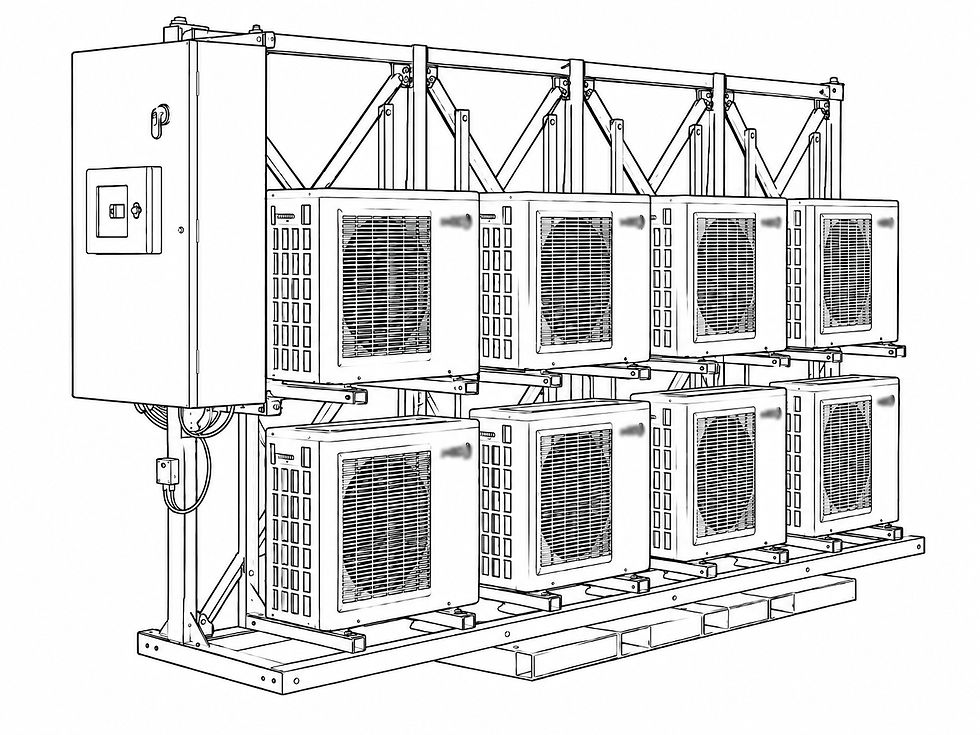
Droplets: Modular Flexibility for Real Buildings
Of course, not every building gives you the perfect mechanical room.
That is why Droplets are such an important part of the WaterDrop product line.
Droplets are modular heat pump arrays that provide flexibility when heat generation and storage need to be separated. They are useful for retrofits, phased projects, space-constrained mechanical rooms, and buildings where a full packaged plant is not the best fit.
This flexibility matters because engineers often have to solve problems inside imperfect buildings.
Droplets allow the design team to apply WaterDrop’s integrated approach without forcing every project into the same physical configuration.
That is a practical advantage.
Controls Make the System Work
Controls are often where system performance is either protected or lost.
In a central heat pump water heating system, controls need to coordinate heat pump staging, storage temperature, recovery, recirculation, backup strategy, and load shifting.
WaterDrop’s DHW Manager helps manage that complexity. It coordinates the system so that the individual components operate as a complete plant rather than as disconnected equipment. For engineers, that matters because controls are not an afterthought. They are part of the performance strategy.

Monitoring Makes Performance Visible
DHW Optics adds another layer of value: visibility.
This is especially important for owners, utilities, and design teams who care about long-term performance.
With remote monitoring, the system can provide insight into operation, performance trends, alerts, and opportunities for optimization.
That means the DHW plant does not disappear after startup. It remains observable.
For engineers, that can be a meaningful difference. It helps support the system after occupancy and gives owners more confidence that their investment is working as intended.

WaterDrop Helps Engineers Reduce Uncertainty
The best engineering solutions are not only efficient. They are practical.
WaterDrop helps address the practical realities that engineers care about:
Can this be installed reliably?
Can the owner understand how it operates?
Can the system be monitored?
Can it meet load without unnecessary oversizing?
Can it support electrification goals?
Can it reduce commissioning surprises?
Can it perform after the project team leaves?
These are not minor questions. They are the questions that determine whether a DHW system succeeds in the real world.
Don’t Accept a Carbon Copy
The industry does not need to keep recreating the same field-built DHW plants and hoping for better outcomes.
Engineers need systems that match the complexity of the buildings they are designing.
WaterDrop provides a better model:
Factory-built system integration
CO₂ heat pump technology
Load-based sizing support
Thermal storage strategy
Skid and Droplet configurations
Integrated controls
Cloud-based monitoring
Long-term operational visibility
That is what makes WaterDrop different.
It is not just a product substitution.
It is a better way to deliver central domestic hot water.


Comments